To get a station hand job in Australia, you need to show employers that you’re reliable, willing to learn and ready for practical livestock and station work, then back that up with a clear résumé, strong applications to pastoral companies and a good attitude at interview. This guide is for anyone trying to land their first station hand role, whether you’re planning a gap year or looking for a long-term start in the livestock industry, especially if you have little or no experience.
You’ll learn what a station hand job actually involves, what experience or tickets help, how to prepare your résumé and application, how to handle interviews, what station life is really like, what mistakes hurt your chances, what pay and accommodation can look like, and where to find current station hand vacancies. For the right person, station work can open the door to outdoor work, practical skills and a close-knit team, so knowing how to apply properly gives you a much better chance of getting hired and settling into the job well.
For many people, working on a cattle station is more than just a job. It is an opportunity to experience life in rural Australia, work with livestock, make lifelong mates and learn practical skills that will stay with you forever.
But while plenty of people dream about station life, employers are looking for applicants who are reliable, practical and genuinely ready to roll up their sleeves.
If you are hoping to secure a station hand job in 2027 (and beyond!), here is what you need to know.
If you are looking for a long-term career or just familiarising yourself with some stations, it is worth getting to know some of Australia's leading pastoral companies. These employers operate individual stations across Queensland, the Northern Territory, Western Australia, South Australia and New South Wales, and regularly recruit for Station Hands, Bore Runners, Machinery Operators, Cooks, Mechanics, Overseers and Managers. Follow each employer page and check the site along with specialized rural employment websites for employment opportunities. Check back regularly for new vacancies and the latest jobs, and use specialized job boards to spot openings quickly.
AACo is Australia's oldest and one of its largest integrated beef producers, operating cattle stations, feedlots and farming properties across northern Australia.
Properties include: Brunette Downs, Anthony Lagoon, Eva Downs, Camfield, Delamere, Avon Downs, Austral Downs, Canobie, Dalgonally, Glentana, Meteor Downs, South Galway, Wondoola and Wylarah, along with Aronui and Goonoo Feedlots.
AAM manages large-scale agricultural investments and cattle properties across northern Australia.
Properties include: Maryfield Station and Limbunya Station in the Northern Territory, along with other cattle and agricultural assets managed across Australia.
Hughes Pastoral is a major family-owned cattle producer with properties across the Northern Territory and Queensland.
Properties include: Inverway, Riveren, Lake Nash, Tierawoomba, Tumbar, Keeroongooloo, Caldervale, Miranda Downs, Millungera and Taylors Plains.
NAPCo is one of Australia's oldest and largest cattle companies, operating across Queensland and the Northern Territory.
Properties include: Alexandria, Mittiebah, Boomarra, Coolullah, Kynuna, Marion Downs, Monkira, Coorabulka, Glenormiston, Cungelella, Mantuan Downs, Portland Downs, Goldsborough and Wainui Feedlot & Farm.
MacLachlan Pastoral Group operates cattle stations in the Victoria River region of the Northern Territory.
Properties include: Wave Hill Station and Killarney Station.
Camm Agricultural Group operates integrated cattle, feedlot, farming and grazing businesses across Queensland.
Properties include: Wonga Plains near Dalby, Melrose near Kingaroy and cattle properties within its North Queensland aggregation near Charters Towers. Wonga Plains also includes the group's large-scale feedlot operation.
Harvest Road operates cattle stations, farming, feeding, processing and aquaculture businesses across Western Australia.
Properties include: Jubilee Downs, Quanbun Downs, Laurel Downs, Minderoo, Balfour Downs, Minilya, Brickhouse, Koojan Downs Feeding Facility, New Norcia Farm and Hill River.
Heytesbury Pastoral operates a well-known portfolio of cattle stations across the Northern Territory and Western Australia.
Properties include: Victoria River Downs, Moolooloo, Pigeon Hole, Mount Sanford, Birrindudu, Flora Valley, Gordon Downs and Nicholson Station.
MDH is one of Australia's largest family-owned beef cattle businesses, running approximately 175,000 cattle across Queensland.
Properties include: Rutland Plains, Dunbar, Brightlands, Chatsworth, Devoncourt, Stradbroke, Nangram, Wallumba Feedlot, Byerwen, Glenprairie, Kerand and Wetherby.
Jumbuck Pastoral is a fourth-generation Australian family business operating large-scale sheep and cattle stations across several states.
Properties include: Meda, Blina, Gunbar, Mount Victor, McCoys Well and Mulgathing.
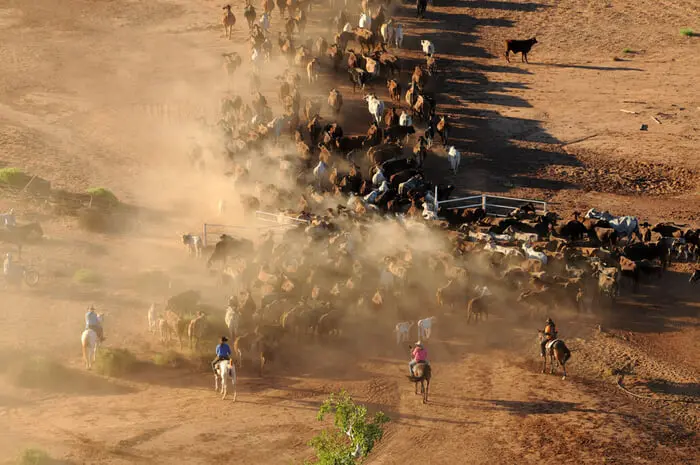
A Station Hand is an important member of a cattle station team, helping with the daily duties on large agricultural properties, including livestock, property maintenance, water infrastructure, agricultural machinery and everyday station operations.
No two days are the same. Depending on the season and property, your work could include, while supporting livestock management and general farm operations:
Mustering cattle on horseback, motorbike or side-by-side
Checking bores, tanks, troughs and watering points
Repairing fences, gates and cattle yards, with the ability to construct and repair fencing especially important
Feeding livestock
Operating tractors and machinery, where competence with machinery and vehicles is highly valued
Completing general maintenance and repairs, including helping maintain equipment and using basic mechanical know-how
Working cattle through the yards during branding, weaning and processing
Cleaning, maintaining and putting equipment away properly
It is hands-on work that suits people who enjoy the outdoors, working in a team and having a go, with a range of practical tasks and physical work.
NOTE: A Station Hand/ Jackaroo/ Jillaroo is also referred to as a Ringer - although sometimes you will find that the title of Ringer does not quite come into effect until you have been a Station Hand for at least 2 mustering seasons.
Check out this blog about Station Hands Lucy Shallcross from the Pilbara in Western Australia, Lucy Simpson from Southern NSW and Alyce Robben from Central Queensland:
Three Station Hands, 1,500 Brahmans and a Kimberley Sunset
Not always.
Many station owners and managers are prepared to employ someone with little or no station experience if they have the right attitude, and many entry-level agricultural jobs do not require formal qualifications or previous experience.
Employers are generally looking for someone who is:
Honest
Reliable
Hard-working
Keen to learn
Safety-conscious
Easy to get along with
Prepared to listen and follow instructions
Your attitude can be your greatest asset, and most station managers hire for attitude and work ethic over degrees. Employers can teach skills through job training, and it is much harder to teach reliability, initiative and a strong work ethic. This also gives beginners a chance to build new skills through on-the-job learning.
Top tip: Do not pretend you have skills or experience that you do not have. Be honest about what you know and show that you are ready to learn.
Before applying, ask yourself whether you are genuinely ready for the work and lifestyle in remote areas.
You should be able to say yes to most of these:
You’re healthy, active, and have high physical stamina for long hours in hot weather and changing conditions.
You’re okay getting dirty, dusty, wet, and sunburnt.
You can lift, carry, climb, and handle manual labour as part of everyday station jobs.
Physical fitness is a core requirement for practical work, not just a nice extra.
You won’t panic around cattle, horses, vehicles, tools, or loud environments.
Station work also changes how you live day to day:
You’re okay living away from family and friends and are comfortable with remote living conditions.
You don’t need nightlife, shopping centres, or constant entertainment.
You can cope with limited phone service, slower internet, fewer trips to town, and the broader working conditions that come with station life.
You’re happy to follow station routines rather than your own schedule.
You can live and work closely with other people without drama.
You are comfortable working outdoors in hot (and cold!), dusty or wet conditions
You can work as part of a small team
You are willing to start with basic jobs and learn
You can take instructions and constructive feedback
You are physically fit enough for practical work
You are comfortable living away from family and friends
You are prepared to look after vehicles, tools and equipment
You understand that station work is not just horses and mustering
You are only interested in riding horses
You are unwilling to do fencing, cleaning or maintenance
You struggle to follow instructions
You expect reliable internet and regular trips to town
You are not comfortable living and working with the same people
You are unwilling to work outside normal office hours when required
You have not researched the employer or property
If you are not quite ready, that does not mean station work is not for you. Spend some time building your fitness, practical skills and understanding of the industry before applying.
One of the first questions many employers ask is:
Can you drive a manual vehicle?
A current manual driver's licence is highly regarded and may be essential for some station hand positions.
Additional licences and qualifications can make you more employable, and even entry-level candidates can strengthen an application with relevant training and practical knowledge:
HR, HC or MC truck licence
First Aid Certificate (especially valued on remote outback stations)
Forklift licence
Chemical accreditation
Chainsaw competency
White Card
Machinery tickets
Motorbike experience
Certificate II in Agriculture
Certificate III in Agriculture or rural operations
Every extra skill gives an employer another reason to shortlist your application and can support future skill development and career progression.
You do not need to have grown up on a cattle station or a farm, and many applicants build relevant experience before they work as a station hand.
Experience gained in other industries can be highly transferable, and employers often value a range of practical competencies, including:
Farming
Feedlot work
Horse riding (if you are asked if you can ride: under promise and over deliver!)
Livestock handling
Fencing
Construction
Welding
Mechanical repairs
Machinery operation
Landscaping
Earthmoving
Warehousing
Hospitality
Even hospitality experience can be valuable because it demonstrates teamwork, communication, long hours and the ability to work under pressure.
A basic low-stress understanding of livestock handling is important, and it helps to arrive with a few practical skills already in place.
For example:
Machinery operation — basic machinery operation is crucial when applying, even if your experience is limited to simple farm equipment or vehicles.
Mechanical repairs — basic mechanical knowledge and a focus on safe operation can make you more useful around the property.
Fencing and welding — these are often in demand and can help you stand out.
Horse riding — useful on some stations, but not essential for every role.
This kind of practical experience helps you hit the ground running and gives applicants unique exposure to station work.
You do not need to be an expert, but understanding the basics before applying shows initiative.
Useful areas to learn about include:
Animal behaviour
Low-stress stock handling
Cattle yard safety
Biosecurity
Animal welfare
Safe horse and motorbike handling
Your résumé does not need to be fancy. It needs to be clear, concise, honest and relevant.
Keep it to one or two pages and include:
A short personal introduction - a photo can make your resume stand out from others
Your employment history
Practical and transferable skills
Licences and qualifications
Livestock, horse or machinery experience
Your current location
Your availability
At least two referees
Your correct phone number and email address
❌ Writing five or six pages
❌ Including irrelevant information
❌ Exaggerating your experience
❌ Leaving out licences and practical skills
❌ Providing referees who have not agreed to be contacted
❌ Using an unprofessional email address
❌ Forgetting to check spelling and contact details
Employers may call quickly, so answer your phone professionally and return missed calls promptly.
Avoid sending the same generic application to every employer.
Your cover letter or application message should briefly explain (2-3 paragraphs):
Why you want to work on a cattle station
Why you are interested in that particular role
What practical skills you can offer
Why you would fit into a station team
When you are available to start
Good application:
“I am applying for your station hand position because I am keen to build a long-term career in the cattle industry. I have experience working outdoors, driving manual vehicles and completing basic mechanical and maintenance work. I am reliable, physically fit and available to start in February.”
Poor application:
“Hi, I need a job. I will do anything. Please call me.”
Write your cover letter in your voice once you've read the role! Employers can usually tell when an application has been AI prepped, copied and pasted without reading the job advertisement.
Station job interviews are often completed by phone or video call.
Before the interview:
Read the advertisement again
Research the station and employer
Prepare examples of your practical experience
Be ready to discuss your availability
Find a quiet place with reliable reception
Have your résumé and questions in front of you
Why do you want to work on a cattle station?
What practical experience do you have?
Can you drive a manual vehicle?
Have you worked long hours outdoors?
How do you respond to feedback?
Are you comfortable living remotely?
Are you comfortable working as part of a small team? Give us some examples - playing team sports at school for example)
When are you available to start?
What does a typical day involve?
What training will be provided?
What is the roster?
What accommodation is included?
Are meals provided?
Will I be working with horses, motorbikes or both?
What clothing and equipment should I bring?
Is there mobile reception or internet access?
What is the station's policy on dogs?
Be honest about what you can and cannot do. It is better to say you are inexperienced but keen to learn than to exaggerate your abilities.
Station work is not just riding horses and mustering cattle.
A large part of the job can involve fencing, checking waters, cleaning yards, servicing equipment, maintaining vehicles and completing general property work.
You may live in staff accommodation, eat meals with your workmates and spend long periods with the same small team. On some properties, employees are offered comfortable accommodation with air conditioning and wifi provided, and communal spaces may also be available for staff to relax together.
Mobile reception and internet access may be limited, although connectivity still varies widely between remote areas and properties. Trips to town may also be infrequent.
Employers value people who:
Pitch in when needed
Respect shared accommodation
Look after vehicles and equipment
Communicate well
Maintain a positive attitude
Work safely
Respect station rules
Being a good team member is just as important as being a capable worker, and many people enjoy the horse culture and station community even though the lifestyle still involves routine work and shared living.
Here is some handy advice from a Head Stockman: Your Actions Will Dictate What Jobs You Get on a Cattle Station
❌ Applying without reading the full advertisement
❌ Sending a generic application
❌ Providing no referees
❌ Using poor spelling and grammar
❌ Exaggerating practical experience
❌ Applying for senior roles without relevant experience
❌ Failing to answer or return phone calls
❌ Having unrealistic expectations about station life
❌ Ignoring licence or work-right requirements
❌ Assuming your dog can come with you
❌ Waiting too long to apply
What a station hand earns varies by experience, location and employer. As a benchmark, a full-time Station Hand earns $1,200 per week on average, or $62,400 before tax annually, and the national average hourly wage is $26.88. In Queensland, salaries can range from $50,000 to $100,000 annually, and experience can lead to higher pay and more responsibility.
Before accepting a role, make sure you understand:
Your wage or salary
Whether the amount is before or after tax
The expected working hours and roster
Whether daily rates apply and if there are paid overtime days
What accommodation is provided
Whether meals are included
Whether accommodation or meals have any deductions
Your leave and superannuation arrangements
Most full-time roles on remote cattle stations include accommodation. Meals may also be supplied, although arrangements vary between stations, and some employers supply bedding, towels, soap and laundry detergent as part of employee benefits.
Ask for the employment conditions in writing before travelling to the property, and confirm salary, top daily rates, overtime and long-term stability in writing before travel.
READ: How much do I get paid on a cattle station?
Your employer should provide a packing list, but common items include:
Comfortable work boots
Long-sleeved work shirts
Jeans or work trousers
Wide-brimmed hat
Sunscreen
Water bottle
Warm clothing for cool mornings and nights
Personal toiletries
Personal medications
Copies of licences and certificates
Suitable casual clothes for time off
❌ Your own saddle
❌ Expensive horse gear
❌ Your own tools
❌ Your own motorbike
❌ A complete new wardrobe
Ask your employer what is supplied before spending money on equipment you may not need.
Yes. Many cattle stations recruit entry-level station hands, jackaroos and jillaroos and provide training on the job. Applicants without station experience should focus on transferable skills, fitness, attitude, reliability and willingness to learn.
There is no single minimum age for working on a cattle station in Australia. It depends on the employer, the type of work and the relevant state or territory employment laws.
Many entry-level station hand, jackaroo and jillaroo roles are suitable for school leavers aged 17 or 18 years and over. Some employers may consider younger applicants who have finished school, while others require applicants to be at least 18 due to the nature of the work, insurance requirements or the operation of vehicles and machinery.
Whilst we also find that many employers prefer their staff to have red Ps licence as a minimum, so 17yo.
If you are under 18, read the job advertisement carefully and contact the employer if you are unsure whether you meet the requirements.
Ultimately, employers are usually more interested in your attitude, reliability, work ethic and willingness to learn than your age. If you're prepared to work hard, listen, learn and be part of a team, you'll give yourself the best chance of landing your first station hand job.
Most full-time station hand roles on remote properties include accommodation. This may be a room in staff quarters, a shared house or separate accommodation. Confirm the arrangements before accepting the position.
Meals are included with some station roles but not all. Check the advertisement and ask the employer whether meals are supplied and whether any deductions apply.
Sometimes, but not always. Each station has its own policy. Never assume your dog can come with you. Ask before applying or accepting the role.
READ: Why some stations don't take dogs
No. Many stations use a combination of horses, motorbikes, side-by-sides, vehicles and helicopters. Riding experience can still be valuable on properties where horses are used regularly.
A manual licence is highly regarded and may be essential for some roles. Read the advertisement carefully and do not apply if you cannot meet a clearly stated licence requirement.
Some stations advertise positions suitable for couples, while others are recruiting for one individual role. Only apply as a couple when the advertisement states that couples are welcome or the employer confirms there is suitable work for both people.
Some employers will begin recruiting in September/ October for the 2027 season - it depends on when the mustering season finishes and who is returning in 2027.
Some will advertise later in 2026, as late as December and into 2027.
So prepare your résumé and referees early and regularly check current vacancies so you can apply quickly.
Landing your first station hand role is not about having the perfect résumé.
It is about proving that you are dependable, practical, willing to learn and ready to have a go.
If you are prepared to work hard, listen, ask questions and embrace station life, your first role could be the beginning of an incredible career.
You might start as an inexperienced station hand and eventually progress into positions such as:
Browse the latest Station Hand Jobs in Australia on RFTTEJOBS.com and take the first step towards working in rural, remote and regional Australia, with some roles available to start asap and room for internal promotion as your skills and experience grow.
Are you an employer looking for station staff?
Advertise your vacancy with RFTTEJOBS.com and reach a highly targeted audience interested in agriculture jobs across Australia.
View employer advertising options